Foreword
The Byzantine Empire lasted eleven centuries, and for almost all of that time, its art depicted the emperor as the embodiment of power. André Grabar, in his seminal work «The Emperor in Byzantine Art» (1936), demonstrated that the iconography of the basileus formed a rigid system, inherited from the Roman imperial cult and reinterpreted within Christian terms. Our goal is to deconstruct this system into its elements and observe how it functions and how it evolves.
Concept
The object of the study was the visual representation of imperial power in the art of the Byzantine Empire from the 6th to the 14th centuries, and the subject was the system of artistic means used to portray this power: the hierarchical scale and placement of the figure within the composition, imperial garments and regalia, interaction with sacred figures, posture and gesture, the composition of the surroundings, and the architectural space.
The hypothesis is that the image of the emperor was constructed not from isolated attributes, but from a stable system of visual characteristics—hierarchical scale, frontality, a fixed set of regalia, and so on. This system remained a unified code from the 6th to the 14th century because what was depicted was not an individual person, but an institution of power. However, the configuration of this code shifted: the emperor of the 6th century is shown centrally amidst a retinue, devoid of a sacred figure. The emperor of the 10th–12th centuries is depicted alongside Christ and the Virgin Mary, positioned below and smaller than them. By the 14th century, a secular dignitary occupied the same visual formula. In other words, the visual language remained stable, but its «bearer» and its position within the formula proved historically fluid.
The materials selected for research included the mosaics of Justinian and Theodora in the Basilica of San Vitale in Ravenna (c. 547); the imperial mosaics of the Hagia Sophia in Constantinople—Leo VI (c. 900), Zoe and Constantine IX Monomachos (1028–1034, revised 1042–1055), John II Komnenos with his family (c. 1118–1134), the portrait of Alexander (912–913), the mosaic in the southwest vestibule featuring Constantine and Justinian (10th century); the Barberini Diptych (525–550, Louvre); the miniature «David and Goliath» from the Parisian Psalter (10th century, BnF, Grec 139, fol. 4v); miniatures from the Madrid Skylitzes (12th century, National Library of Spain); the Monastery of Nea Moni on Chios (11th century); and the mosaics of the Church of Hora in Constantinople (c. 1316–1321). The subjects covered include painting (miniature), mosaics, carved relief, and architecture; the chronological scope spans the 6th–14th centuries, divided into Early Byzantine, Middle Byzantine, and Late Byzantine periods.
What visual elements shaped the image of the emperor as a bearer of both political and sacred power in Byzantine art?
Navigation
1. Introduction
2. Scale and Compositional Hierarchy
3. Garments and Regalia
4. Earthly and Divine Power
5. Architecture as a Frame for the Imperial Image
6. Conclusion
7. Bibliography
Scale and compositional hierarchy
The placement of figures on the plane in Byzantine art is an assertion of their place in the world. The Emperor is almost always positioned at the center or on the axis of symmetry. If a sacred figure is present in the composition, it is given either the center position or a greater size.
Missouri Constancia II, 343 AD, Kerch.
In the Massary of Constance II, a mounted figure is depicted, rising above the surrounding characters. His figure stands out due to the rider’s placement, imperial regalia, and gesture of triumph. Flanking him are the winged Victory and a warrior, while the horse treads upon the shield of a defeated adversary. The scale and composition emphasize the emperor’s superiority as a military leader, whose power is tied to victory and the support of higher powers.
Missori Feodosius I, 388 CE, Madrid.
In the Mosaics of Theodosius I, the emperor is also presented at the center of the composition, seated on a throne beneath a monumental architectural arch. His figure is significantly larger than the co-rulers depicted on either side—Valentinian II and Arcadius—as well as the other characters. The differences in scale, positioning, and architectural framing establish a strict hierarchy, in which Theodosius holds the supreme position even among other emperors.
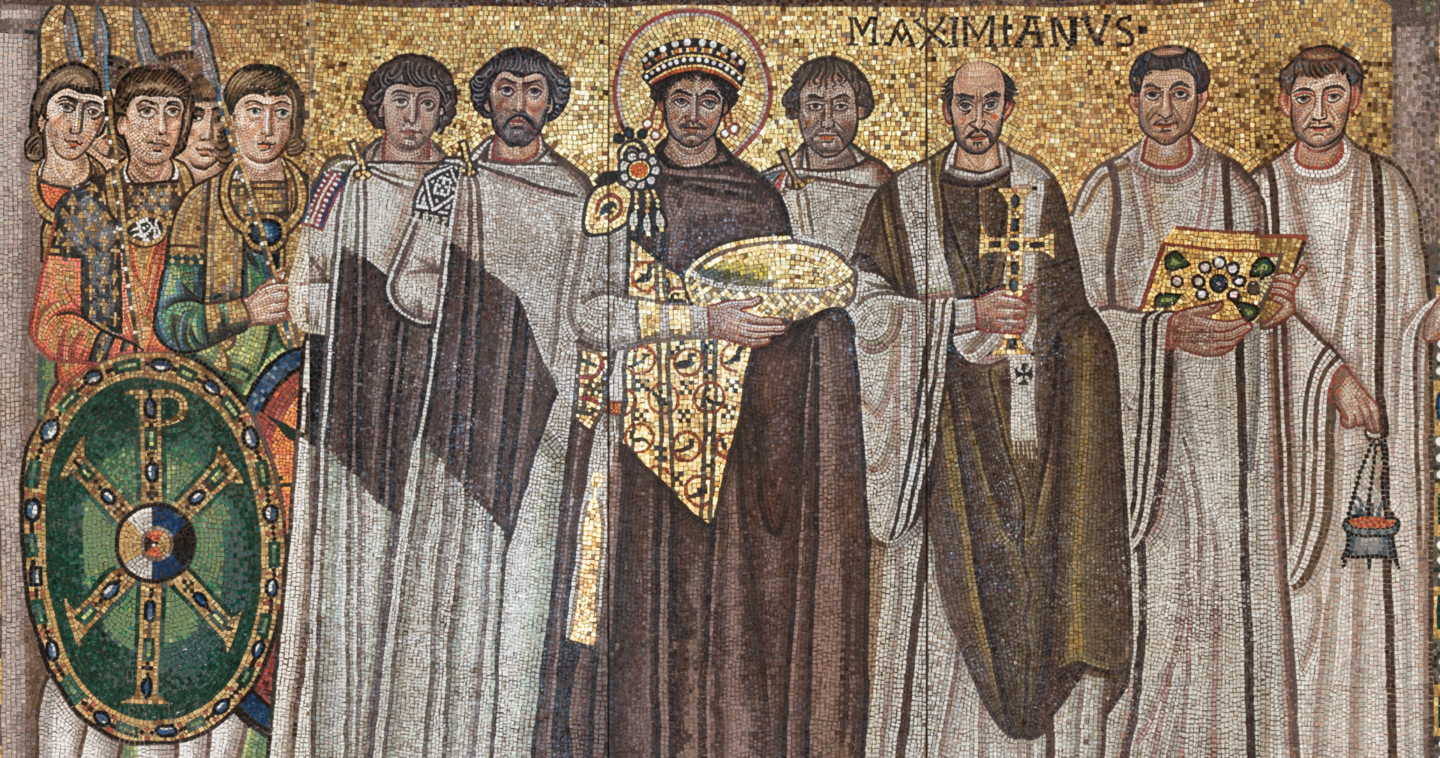
Mosaic «Emperor Justinian with his entourage, ” c. 547, Basilica of San Vitale, Ravenna.
Emperor Justinian is also positioned at the center of the frieze, yet his scale is almost the same as that of his retinue. Parts of the surrounding heads are turned toward him, their bodies forming a living frame. He is no larger than the others, but his preeminence is established through three elements: his central placement, the orientation of his retinue, and his halo.
Mosaic: «Empress Theodora with her Entourage, ” c. 547, San Vitale.
In Theodora’s mosaic, just as in the depiction of Justinian, the central figure stands out among the surrounding characters. The Empress occupies the leading position in the composition. Courtly women and accompanying figures are positioned on either side of the Empress, forming a ceremonial entourage around her. Their placement and grouping are subordinate to the central figure.
Meanwhile, the scale of the empress is comparable to the scale of the emperor in the opposite panel and is almost identical to that of the accompanying retinue. The significance of the figure, as before, is determined by its placement and the totality of its visual attributes.
The examples demonstrate that the placement and scale of a figure help establish hierarchy, but they are utilized in varied ways. In the San Vitale mosaics by Justinian and Theodora, status is primarily emphasized through central placement, halos, and attire, whereas in other works, the difference in size may be far more pronounced. The following examples illustrate how the ruler’s status is further denoted through costume and regalia.
Attire and Regalia
Imperial attire in Byzantine art was not merely a part of courtly appearance, but also a crucial indicator of status. Purple fabrics, gold detailing, diadems, and other elements of the costume are repeated across images from different eras. Because of this, the viewer could recognize the character’s standing even if they did not know their face or name.
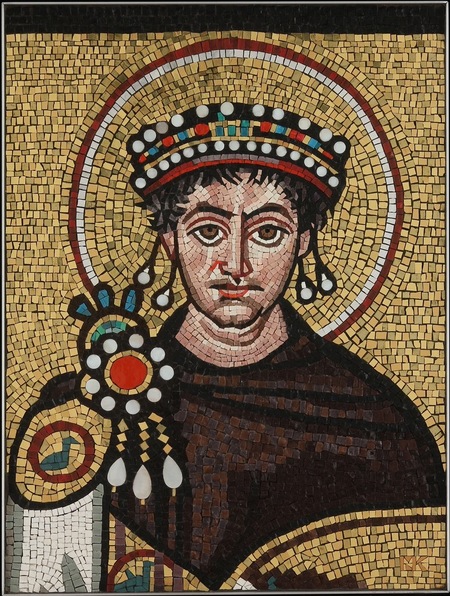
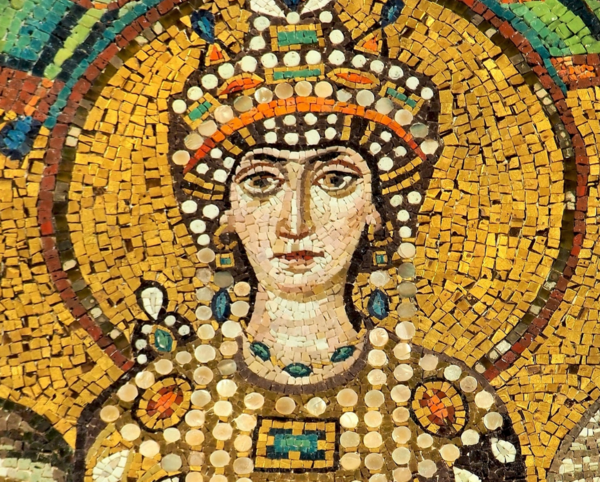
Mosaic «Emperor Justinian with his retinue,» circa 547, Basilica of San Vitale, Ravenna, and Mosaic «Empress Theodora with her retinue,» circa 547, San Vitale.
Justinian is draped in a purple chlamys with a gold tablet, a fibula clasp, and a stemma featuring prependula. Theodora wears a crown with pendants, and the diadem has a pearl border. These three materials carry a unified meaning: purple was a color monopolized by the state, gold was sacred, and gemstones served as visible proof of divine patronage.
Portrait of Emperor Alexios Mosaic in the Northern Gallery of Hagia Sophia, 912–913.
In the mosaic, Emperor Alexander is depicted in full length and in a frontal pose. Special attention is drawn to his attire: an ornate crown adorned with precious stones and pendants, a loros with pearl and gold trim, and red shoes. The Emperor holds a scepter and an acakia—objects that complete his image as a symbol of power.
The crown signifies imperial status, while the laurel wreath and precious detailing emphasize the ruler’s elevated position, and the color and materials enhance the solemnity of the image.
Using these mosaics as an example, one can see that imperial attire in Byzantine art was an essential element of depicting power. Purple garments, gold trim, precious stones, crowns, and specialized regalia not only demonstrated the ruler’s wealth but also helped the viewer recognize their status.