Content:
1. Concept
2. Main Body 1. Anthony Hernandez: Homelessness as Landscape 2. Desire van Hook: Material Culture of Skid Row 3. Mary Ellen Mark: Street Youth and the Long-Term Portrait 4. Bruce Davidson: Intimacy, Vulnerability, and the Urban Environment 5. Shane Rosello: Co-participation and the Voices of Participants 6. Scott Sutherland — Look at Me 8. Brooklyn Photo Books of 1969: Early Practices of Self-Representation
3. Conclusion
1 / Concept
A photobook is not merely a way to preserve photographs; it is a distinct visual medium capable of influencing how society perceives individuals existing on the margins of the social norm. Homeless people, street communities, migrants, youth subcultures, individuals with addictions, workers in informal sectors, and other groups often find themselves on the «edge of visibility»: they are physically present in the city, yet in the media, political discourse, and everyday perception, they frequently remain anonymous, stigmatized, or reduced to a symbol of a social problem.
The central question of the project is how the design and visual language of the photobook form the image of marginality and influence the complicity of the person captured in the frame. Photography is not neutral documentation of events: the choice of angle, distance, light, fragment, image sequence, spread size, font, and paper quality determines whether the subject is perceived as an individual, a «social case,» a victim, or part of a subculture. Therefore, in this study, the photobook is analyzed not just as a collection of images, but as a holistic design object where the content, layout, rhythm of the spreads, typography, and material quality of the book all contribute to the creation of meaning.
Historically, the theme of marginality in the photographic book has evolved alongside documentary photography and street photography. In the mid-20th century, photographers turned to impoverished neighborhoods, teen groups, urban peripheries, and people living outside the center of events. However, this perspective often remained external: the photographer observed the community, documented it, and interpreted it for a broader audience. Over time, there has been a growing aspiration in photographic books not just to «show others, ” but to give them a voice of their own. This is manifested through the inclusion of letters, interviews, personal documents, handwritten notes, and photographs taken by the project participants themselves. Especially crucial for research is the distinction between representation and self-representation. In the former case, the marginalized group is depicted by an external author: the photographer decides what is worthy of attention and sets the framework of perception. In the latter, community members are given a camera, participate in image selection, write texts, or become co-authors of the publication. There is also a third approach—filming the reaction to members of marginalized groups from a first-person perspective: that is, the photographer personally adopts the guise of their subject of study. This approach shifts the traditional hierarchy of „photographer—subject of the shoot“ and allows homelessness, street life, or subculture to be shown not as a problem that needs explaining to the viewer, but as an experience possessing its own logic, language, aesthetic, and forms of survival.
Photo book design in this study is examined as an ethical tool. A large portrait can restore an individual’s personality, while fragmented images can convey the fragility of existence; blank spreads, narrative breaks, coarse paper, photocopies, textures, or the aesthetics of self-publishing can amplify the sense of distinctiveness of the street environment. The photo book author’s task is not to embellish social pain, but to find a form that preserves the dignity of the subject, does not oversimplify their experience, and does not turn marginality into spectacle. The visual research is built upon an analysis of several key photo books and photographic projects. It examines works where homelessness is shown through landscape and objects, such as Anthony Hernandez’s «Landscapes for the Homeless» and Desire van Hook’s «Skid Row»; projects based on immersion in street subcultures, like Mary Ellen Mark’s «Streetwise»; as well as publications where participants become co-creators of the images, including Shane Rosello’s «The Reflection in the Pool» and Scott Sothern’s «Look at me.»
The final concept of the project is that the photobook can do more than simply document the boundary between the «normal» and the «marginal»; it can visually reconfigure it. It has the power to restore identity, voice, and narrative to people whom the city and media are accustomed to seeing only as background, a problem, or an object of pity. The research focus is not on finding the «correct» depiction of marginality, but on analyzing how visual and design decisions shape the relationship among the viewer, the photographer, and the subject. The photobook becomes a space of encounter where the invisible can be noticed, and vulnerability can be revealed without sacrificing dignity.
Anthony Hernandez: Homelessness as Landscape
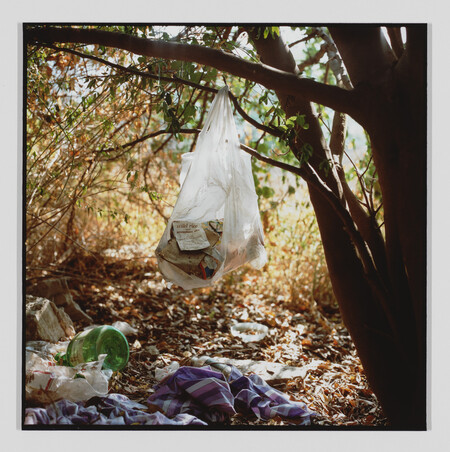
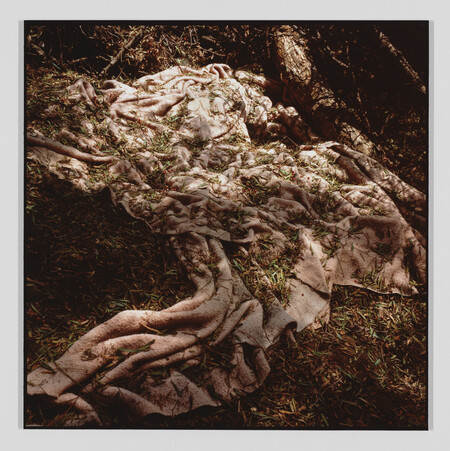
Anthony Hernandez, «Landscapes of the Homeless,» No. 1 (1988) / No. 6 (1988)
In the book «Landscapes for the Homeless» (1995), American photographer Anthony Hernandez investigates not individual people, but the spaces in which they live. The series was created in Los Angeles between 1988 and 1991 and focuses on the temporary shelters of the homeless—under freeways, on vacant lots, near fences, and in other urban zones that typically go unnoticed by residents. Hernandez does not present sensational scenes of poverty; instead, he shows traces of presence: tents, cardboard structures, blankets, trash, shadows, and roads. Hernandez’s primary visual technique is distance. His camera is often not placed close to a person, but at a remove that allows the entire environment to be visible. Because of this, homelessness is presented not as an isolated tragedy, but as an integral part of the urban landscape. The spaces depicted are simultaneously exposed and concealed—they are in the heart of the city, yet they are overlooked by most passersby.
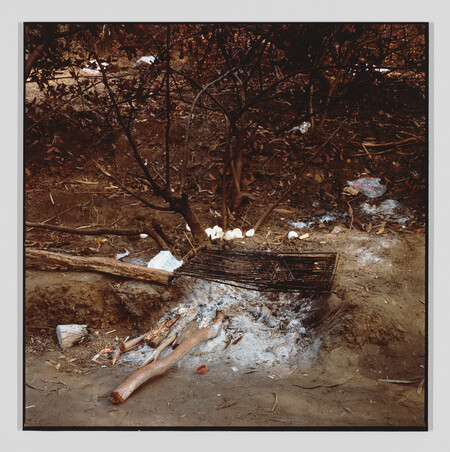
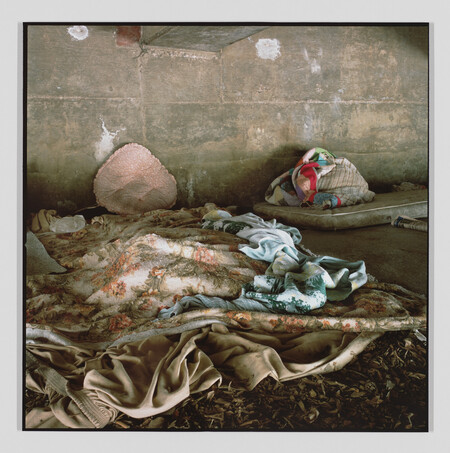
Anthony Hernandez, «Landscapes of the Homeless,» No. 3 (1988) / No. 43 (1990)
Hernández’s composition is also significant. He frequently employs fragments, roads, fences, shadows, or voids to convey the atmosphere of a dwelling. A person may be absent from the frame, but their presence is perceived through objects and traces. This method prevents an excessive focus on individual identity and avoids reducing the homeless person to an object of pity. Simultaneously, the absence of people can be read as a visual metaphor for social invisibility: the city sees the space, but it fails to see those who live within it.
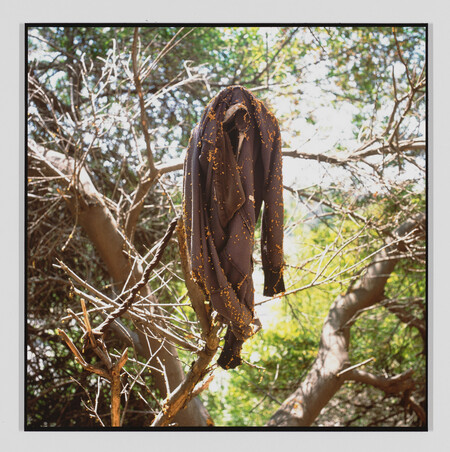
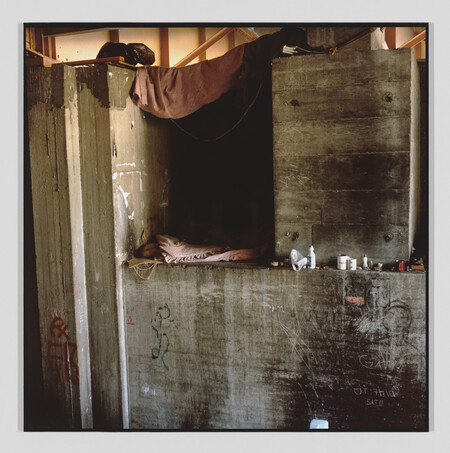
Anthony Hernandez, «Landscapes of the Homeless, ” No. 38 (1990) / No. 42 (1990)
Anthony Hernandez, «Landscapes of the Homeless,» No. 15 (1989)
Desire van Hook: The Material Culture of «Skid Row»
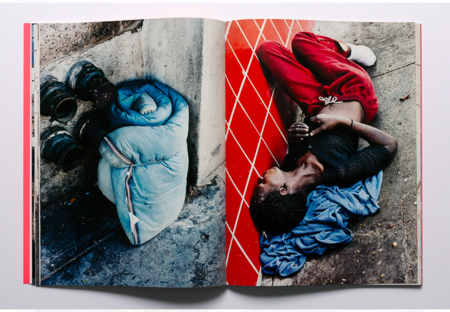
The book «Skid Row» (2015) by Desire van Hook focuses on a Los Angeles neighborhood known for its high concentration of people who are experiencing or have experienced homelessness. Unlike Hernandez, van Hook concentrates more closely on the immediate material world of the neighborhood. Her photographs explore carts, blankets, cardboard, tents, shoes, personal belongings, sidewalks, and temporary structures. These objects become not mere details, but attributes of survival and spatial arrangement.

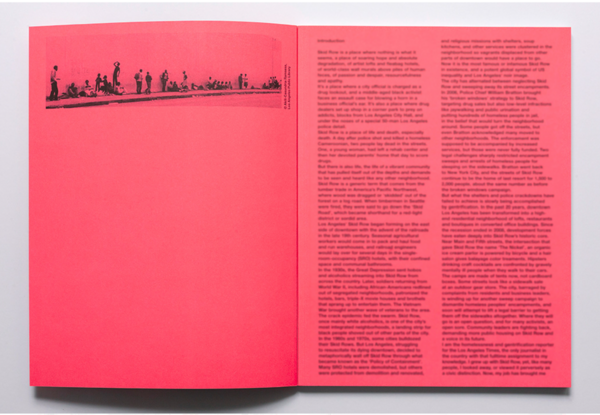
Desire van Hook «Skid Row» (2007–2015)
Van Hook, much like Antoni Hernandez, demonstrates that shelter is not necessarily a building. It can be a corner under a bridge, a section of sidewalk, a cart, a tent, or a structure made from found materials. The photographs capture how an individual creates a minimal yet functional space despite the lack of stable housing. This approach shifts the focus from the image of the «homeless person as a victim» to the image of a human who continues to live, adapt, and organize their daily life.
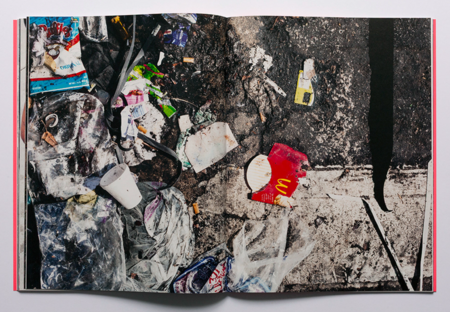
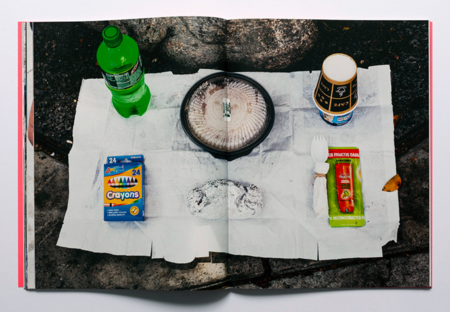
Desire Van Hook «Skid Row» (2007–2015)
The book design, executed by Mevis & Van Deursen Studio, supports this idea. What matters is not only the photography but also the rhythm of the spreads, the scale of the images, the use of white space, and the sequencing of visual elements. The book does not strive for the effect of a continuous documentary reportage. Instead, it allows the viewer to pause, examine the object, and perceive the connection between person, thing, and place.
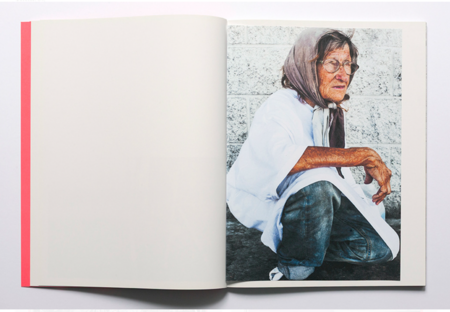
Desire van Hook «Skid Row» (2007–2015)
IMAGE DESCRIPTION
For the study, the photobook «Skid Row» is especially valuable as an example of a «portrait through objects.» The photograph here does not require a person to be in the frame to tell their story. The object becomes the carrier of biography: it points to their vulnerabilities, habits, needs for basic necessities, and the desire to preserve personal space. The concept of this photobook allows us to speak about a person without turning them into an object of forced display.
Mary Ellen Mark: Street Youth
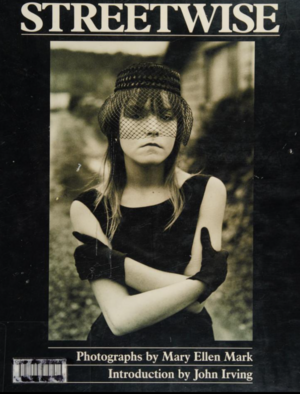
Mary Ellen Mark, «Streetwise» (1988)
Mary Ellen Mark is one of the key artists who worked on the themes of street youth, homelessness, and marginal communities. Her project, «Streetwise, ” began in Seattle in 1983 and focused on teenagers living on the streets—runaways, young people without stable housing, those who are exploited, those struggling with addiction, or those in family conflict. The book combines photography with texts and the heroes' commentary, making it an important example of documentary photography where the voices of the participants matter.
Mary Ellen Mark, «Streetwise» (1988)
Mark’s primary method is interaction. She didn’t just visit communities to capture a few striking shots; she built relationships with its members. Because of this, her portraits carry a distinct level of trust: the person in the frame doesn’t look like a random passerby or a «representative of a social problem.» Instead, they appear as an individual with a name, character, a history, and their own system of values.
Mary Ellen Mark, «Streetwise» (1988)
Mary Ellen Mark «Streetwise» (1988)