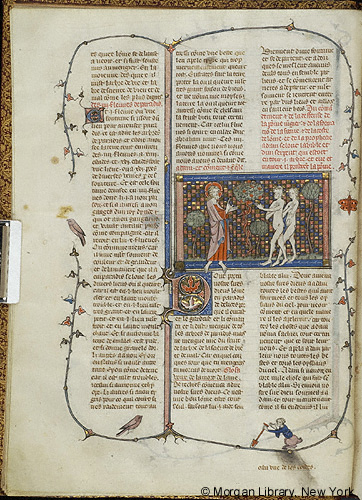
The visual study explores the evolution of the Tree of Knowledge image in Western European art from the 4th to the 14th centuries. The objective is to trace how this abstract theological symbol gradually transformed from a simple representation into a detailed figure, and subsequently, into a spatial element within a composition. The study analyzes key artifacts, including the early Christian sarcophagus of Junius Bassus, Byzantine mosaics from Sicily (Monreale, Palermo), Gothic book miniatures, and the frescoes of Giotto and Ambrogio Lorenzetti. The research demonstrates that the turning point in the depiction of the Tree occurs in the 14th century, influenced by Proto-Renaissance: natural elements cease to be merely «flat symbols» and begin functioning as tools for conveying depth, light, and narrative.
CONCEPT
The history of the depiction of the Tree of Knowledge in Christian art is a gradual «humanization» of the sacred symbol. Early Christian masters viewed this tree primarily as a theological formula: through it, death entered the world, and through the Cross, death was vanquished. In early depictions, the tree is extremely schematic—it is not a plant, but a sign, almost a hieroglyph, pointing to the event of the Fall.
One of the earliest examples is the sarcophagus of Junius Bassus, created around 359 CE and housed in the Vatican Museums. The Fall of Man is depicted on it in an extremely laconic manner: a few branches, a fruit, an outstretched hand. There is no bark, no foliage. For the early Christian artist, the action, not the tree, was what mattered.
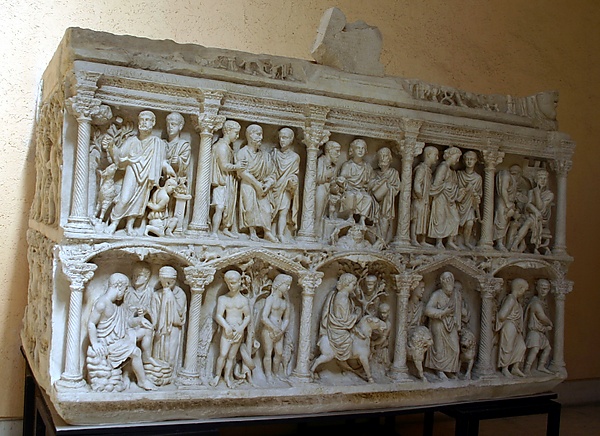
Sarcophagus of Junius Bassus (fragment), ca. 359, Vatican Museums.
The Byzantine tradition, inherited by Sicily, retains this convention but adds a sense of spectacle. In the Cathedral of Monreale, the mosaics of the Creation cycle were created between 1183 and 1189 by Byzantine masters who worked alongside local artisans. The Tree of Knowledge here is part of a symmetrical composition, entwined by a serpent, with fruits of almost geometrically perfect shape. The golden background emphasizes the timeless, sacred nature of the event—it is not an event in a garden, but an event in eternity. An important detail: the fruits depicted in the Monreale mosaic are figs, not apples.
Mosaic «The Creation of Eve» (fragment), Montreal Cathedral, Italy, late 12th century.
Theological Context
In the Middle Ages, the Tree of Knowledge was often confused with the Tree of Life. Genesis states that both trees were located «in the midst of the garden» (Genesis 2:9), and this spatial coincidence created a visual ambiguity. On many depictions, it is impossible to definitively determine which tree we are viewing: the one that is supposed to be the «tree of death» sometimes appears lush and fruitful, like the tree of life.
Gender Aspect
Medieval iconography persistently placed the blame for the Fall on Eve. Furthermore, the devil, often depicted winding around the trunk of the tree, was frequently given a female face in Western European tradition starting in the 13th century—a visual strategy that linked temptation to the feminine nature.
Fruit Symbolism
In Eastern tradition, the forbidden fruit is the fig. In the West, it is the apple. This confusion arose from the Latin translation of the Bible (the Vulgate), where the word malum simultaneously meant «evil» and «apple.» Artists in Western Europe, following the text, depicted the apple without realizing that the original reference was to the fig.
The Symbolism of the Leaf
After the Fall, Adam and Eve cover their nakedness with leaves. In Eastern tradition, this leaf is from a mastic tree; in the West, it is a grape leaf. The grape leaf is not accidental: it alludes to the symbolism of Christ as the «bunch of grapes» from which the wine of the Eucharist is made. Thus, even in detail, the theological program of salvation is embedded.
At what stages and through what means did medieval artists transform the abstract symbol of the Tree of Knowledge into a concrete, detailed, and compositionally active image?
The turning point occurs in the 14th century when, influenced by the Proto-Renaissance, natural elements in sacred scenes cease to be «flat symbols» and begin to function as spatial and emotional instruments.
The study is divided into four chronological blocks: (1) Early Christian and Byzantine Symbol (4th–12th centuries); (2) Romanesque Mosaic and the «Gold Ground» (12th century); (3) Gothic Miniature and Narrative (13th–14th centuries); (4) Proto-Renaissance and the Birth of Space (14th century).
EARLY CHRISTIAN AND BYZANTINE SYMBOLISM (4th–12th Centuries)
The Sarcophagus of Junius Bass is a key monument from this period. The figures of Adam and Eve are also schematic: their bodies lack volume, and their poses are frozen. This is typical of Early Christian art, where meaning predominates over form.
Sarcophagus of Junius Bassus (fragment), circa 359 AD, Vatican Museums.
In the Palatine Chapel in Palermo (mosaics from the 1140s–1170s), the emphasis shifts differently: in the scene of the Fall, the tree is almost absent, and attention is focused on the figure of God and awakening Adam. This is an important stage—the Tree has not yet become an independent «character» in the composition; it is merely background.
Mosaic «The Fall of Man» (fragment), Palatine Chapel, Palermo, 1140–1170.
In the «Adam in Paradise» scene from Montreal, no single tree is designated as the «forbidden» one. This is an important nuance: in early cycles, the Tree of Knowledge is often not individualized; it is dissolved into the paradise garden. A viewer of that era, unfamiliar with the subtleties of exegesis, would likely not have been able to pinpoint exactly which tree caused the expulsion.
Cathedral in Montreal, Italy, late 12th century.
ROMANESQUE MOSAIC: A SYMBOL IN THE «GOLDEN SPACE»
The Cathedral of Monreale is one of the largest monuments of the Norman Kingdom of Sicily. The mosaics cover approximately 10,000 square meters, and their creation involved both Byzantine masters from Constantinople and local artists, as evidenced by inscriptions in Greek and Latin. The style is attributed to the so-called «Komnenian Renaissance"—the period of the Komnenian dynasty’s rule in Byzantium, characterized by anti-classical motifs, yet also exhibiting new features typical of the Romanesque style.
In the scene of «The Creation of Eve, ” the tree functions less as a specific plant and more as an indicator of Paradise as a place. Its form conforms to the overall rhythm of the mosaic frieze. The fruits are almost geometrically perfect, and the trunk itself is entwined with a serpent that holds a fig and offers it to Eve.
GOTHIC MINIATURE: NARRATIVE AND DETAIL (13th–14th Centuries)
Book miniature — the main «experimental proving ground» of Gothic art. Here, artists can afford more detail than in monumental painting, and it is here that the Tree of Knowledge begins to «grow» leaves and fruit.