How did patronage, commerce, and the workshop influence what the artist painted and what the buyer saw in the picture?
Navigation
01 Research Concept 02 Urban Buyers and Patrons 03 How Paintings Found Their Buyers 04 Pace and Volume 05 Rarity and Patronage 06 Rembrandt’s Workshop 07 Artists' Specializations 08 The Market Within Painting 09 Conclusions 10 Summary 11 Bibliography 12 Image Sources
Concept
Dutch painting of the 17th century is often studied through individual artists and genres. I am interested in what changes if we trace a painting’s journey from the artist’s studio to a wall—be it in a private home, a corporate hall, or a collection. In the Republic of the United Provinces, artists could work by commission, paint for open sale, or sell through intermediaries. The same work could later re-enter the market. The reduction of ecclesiastical patronage following the Reformation altered the pool of buyers. Families and urban corporations continued to commission portraits, while finished landscapes, still lifes, and genre scenes might await a buyer in the studio or at a merchant’s shop. This environment allows for a connection between art history and the themes of the course «Business Models in Art History"—who paid for the work, how the artist managed production, and what made their paintings appealing to a buyer. The central question of this research is whether it is possible to determine the conditions under which a painting was created based on its format, manner of brushwork, palette, and subject matter. My hypothesis is that certain techniques relate to the organization of labor and buyer expectations. A limited palette and the repetition of a motif allowed the artist to vary a familiar composition. Meticulous finishing and a recognizable style could increase a collector’s interest. To test this connection, I am examining several cases where a similar visual characteristic receives different explanations.
The body of research includes works primarily associated with Delft, Amsterdam, Haarlem, and Leiden. Two versions of Jan van Goyen’s Dordrecht allow for a comparison of how one artist altered his palette and composition when repeating a motif. Small works by Frans Hals and Gerrit Dou help explore what the format communicates when texture and degree of finish differ. Rembrandt’s canvases and those from his workshop demonstrate how general techniques were passed from master to apprentice. Willem van Haacht’s Antwerp Gallery is introduced as a comparative example from the Southern Netherlands, where the practice of collecting itself became the subject of the painting. The visual analysis is built upon comparing entire pieces with enlarged fragments. I pay attention to the dimensions of the originals, the repetition of compositions, the visibility of the brushstroke, and the handling of details. Subsequently, I cross-reference these observations with museum catalogs, provenance history, and auction records. The commission for «The Night Watch» helps explain its scale and the composition of the group. Records of the sale of «View of Delft» indicate the resale price. Information on Gerrit Dou and Pieter Spiring reveals another means of earning income—a fee for the right to be the first to select an artist’s works. The level of documentation regarding early owners and transactions varies among the selected paintings. Therefore, the painting characteristics provide a basis for hypotheses about production, while specific prices, the original buyer, and commission terms are established through documents when they are available. Comparing these testimonies helps to understand which of the artist’s decisions can be linked to the market and where room remains for other explanations.
Urban buyers and clients
In the Republic of United Provinces, private collectors and urban corporations broadened their circle of patrons. An artist could rely not only on commissioning new work but also on selling finished pieces.
This shift is evident in three places where a painting might have hung: the church interior became a subject, the private residence became the display space, and the musketeer hall became the setting for a collective commission.
Church Interiors After the Reformation
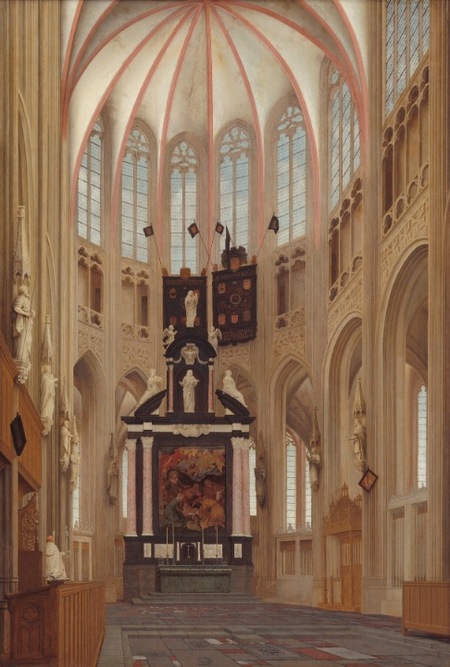
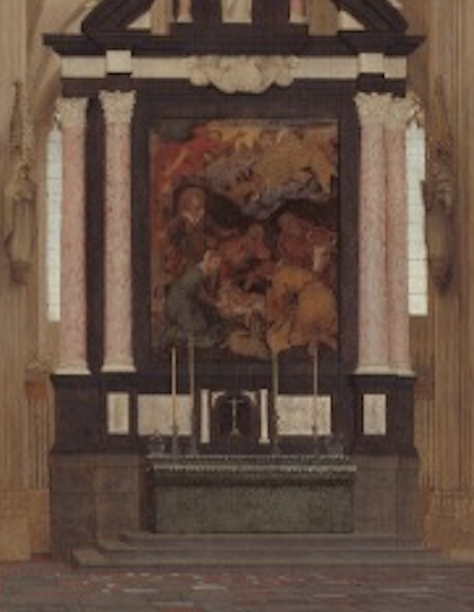
Pieter Jansz Sandredam. «St. John’s Cathedral in Hertogenbosch.» 1646
DETAIL Look at the repeating columns and arches. They guide the eye toward the distant passageway. The people below primarily serve as a measure of the building’s height. INTERPRETATION Sanredam transforms the sacred space of a church into an object of contemplation. This shift is visible in the distribution of attention between the architecture and human action.Following the Reformation, the traditional ecclesiastical commission decreased, though biblical narratives persisted in panel painting.Sanredam’s interior presents a different approach to the church theme: the artist builds the composition around the building’s scale and the rhythm of the arches. In this example, one can trace how the temple’s architecture becomes an independent motif.
The Home as a Space for Art
Jacob Ochtervelt. «Nanny and Child in Fancy Dress.» 1663
DETAIL Framed paintings are visible above the figures and in the background. The viewer’s gaze first travels across the floor tiles before discovering the hanging art. INTERPRETATION Painting is incorporated into the domestic setting. The image illustrates the placement of the artwork within an interior space, and the inventory descriptions help to gauge how common this practice was.
Corporate Commission
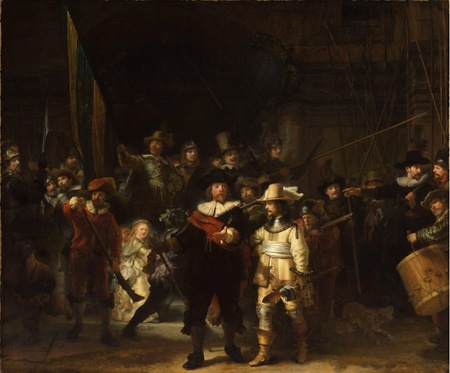
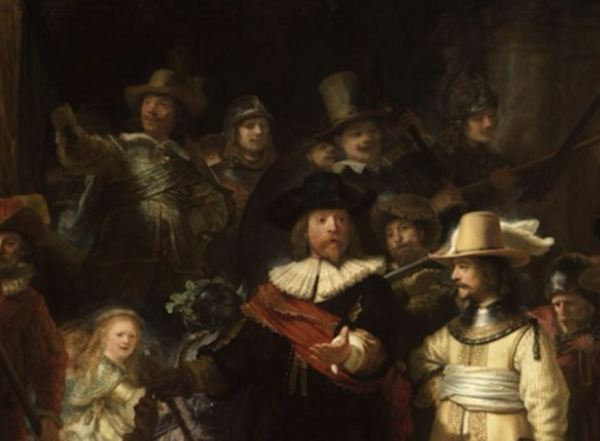
Rembrandt van Rijn. «The Night Watch.» 1642
DETAIL The lieutenant’s light-colored uniform stands out against the captain’s dark silhouette. The captain’s arm reaches forward, and the spears draw the viewer’s gaze into the distance. INTERPRETATION The figures were legible even from a distance in the hall of spearmen. Rembrandt used the scale of the commission to give the corporate portrait the appearance of action—a moment the viewer catches at its outset.
How the painting found its buyer
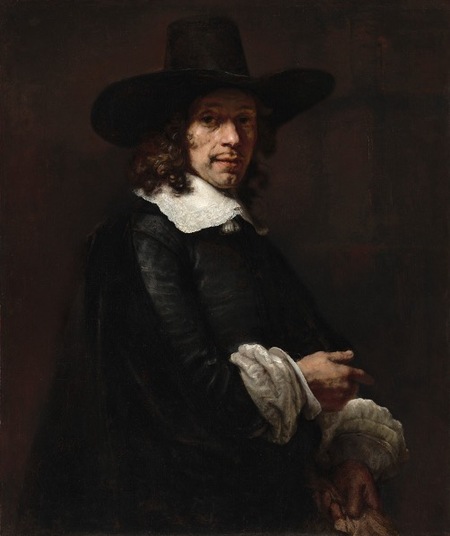
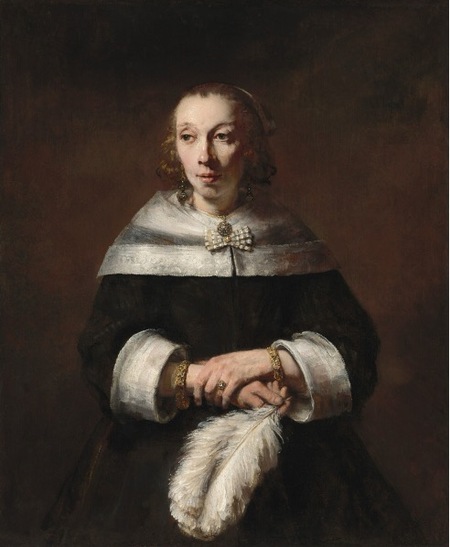
Rembrandt van Rijn. «Portrait of a Man in a Tall Hat and Gloves.» c. 1656–1658 Rembrandt van Rijn. «Portrait of a Woman with an Ostrich Feather Fan.» c. 1656–1658
Two canvases are almost equal in size. In one, a white collar extends into gloves; in the other, a light trim echoes in the fan’s feathers. The figures are turned toward each other. The repetition of size and the recurrence of light details allow the portraits to be read as a pair. The connection between the two images is vital for their joint display.
DETAIL In the paired portraits, one can see how the artist solves the problem of a specific ensemble. Poses, scale, and light connect the two paintings. INTERPRETATION In the open market, the initial concept belonged to the artist himself. The motif needed to be understandable and appealing to a viewer the master had not yet met.
Sale of a finished painting
Dirk Hals. «Merry Company on the Terrace.» 1625
DETAIL Figures gather around conversation and music. A situation links them, and individual faces yield in importance to costumes, gestures, and poses. INTERPRETATION Thanks to the recognizable scene type, the viewer could select a ready-made painting even though the characters' names were unknown to them. Selling a finished work left the author the freedom to choose a motif until meeting the buyer.
From Collection to Auction
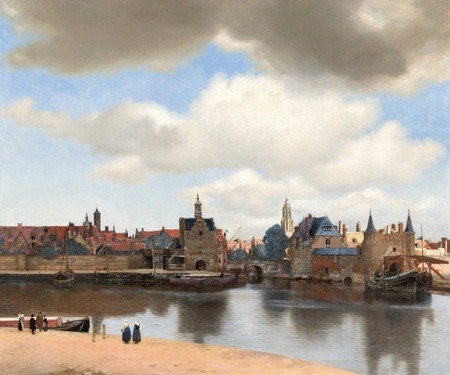
DETAIL From the water, the towers, gates, and boats are visible. The horizontal strip of the shore gives the city its recognizable silhouette. INTERPRETATION The description of Lot #31 in the Dissius auction corresponds to a view of the city from the south. In this case, the motif helps connect the archival record with the object that has survived to our day.Jan Vermeer. «View of Delft.» c. 1660–1661
The price appears in the document.
Johannes Vermeer. «View of Delft, ” fragment. circa 1660–1661
DETAIL The fragment shows that Vermeer highlights the distant tower with light while darkening the coastal facades. The view of the city is composed of selected accents. INTERPRETATION A sales record from 1696 adds a separate fact: the buyer paid 200 guilders. This figure relates to the resale, and the artist’s fee for the painting remains unknown.
Speed and Volume
Repeating motif